
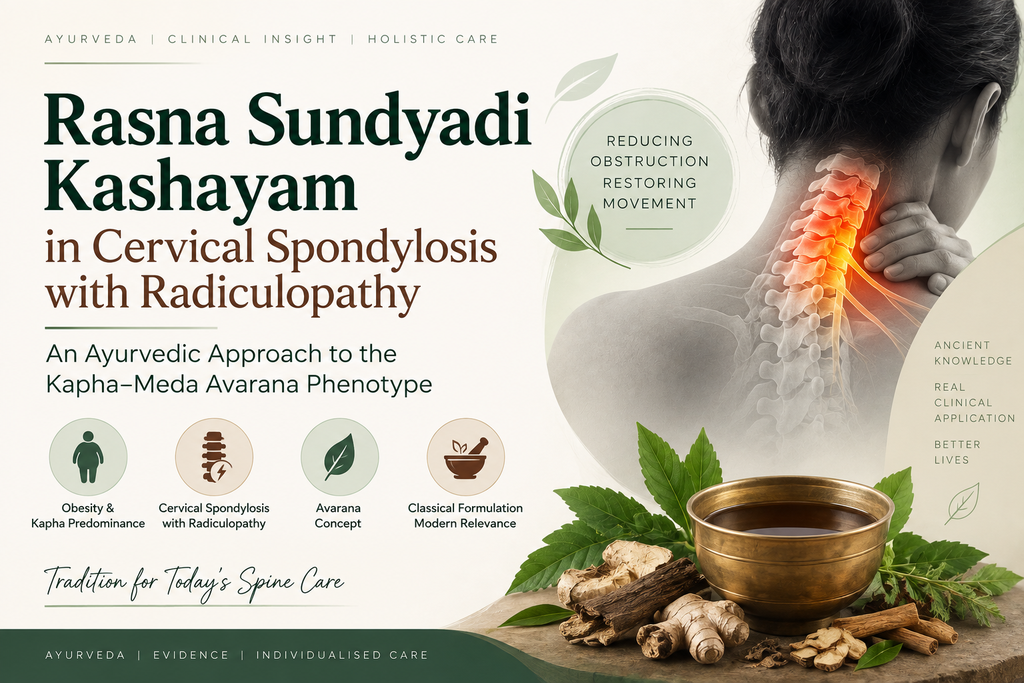
Cervical spondylosis with radiculopathy is a common degenerative cervical spine disorder in which structural changes involving the intervertebral discs, uncovertebral and facet joints, osteophytes and neural foramina may result in cervical nerve-root irritation or compression. Although age-related degeneration is an important determinant, increasing evidence suggests that systemic metabolic factors, including obesity and metabolic dysfunction, may influence the development and clinical course of degenerative spinal disorders.
From an Ayurvedic perspective, cervical spondylosis cannot be equated with a single classical disease entity. A clinically important subgroup, however, may be interpreted through the concept of Āvaraṇa, particularly when Vāta is functionally obstructed by Kapha and Meda. Such patients may present with obesity, gaurava, stambha, reduced mobility, heaviness, muscular tightness and pain associated with a predominantly Kapha–Meda phenotype.
In this context, Rasna Śuṇṭhyādi Kaṣāya provides an interesting therapeutic model because its classical composition contains predominantly uṣṇa, dīpana, pācana, vāta-kapha-hara and śūla-prasamana oriented drugs. The formulation is described in Sahasrayogam for conditions including manyāstambha, kaṭiśūla, sandhiśūla and generalized pain.
The present article proposes a phenotype-based rationale for employing Rasna Śuṇṭhyādi Kaṣāya in obese patients with cervical spondylosis and radiculopathy in whom a Kapha–Meda-associated Āvaraṇa pattern is clinically evident. The proposed mechanism is not a claim of direct equivalence between cervical radiculopathy and classical Āvaraṇa, but a translational Ayurvedic framework in which the obstructive component is addressed before moving toward more intensive Vāta-pacifying and snehana therapies.
Keywords: Rasna Śuṇṭhyādi Kaṣāya, cervical spondylosis, cervical radiculopathy, Āvaraṇa, Kapha, Meda, Vāta, obesity, Manyāstambha, Ayurvedic therapeutics.
1. Introduction
Cervical spondylosis is a degenerative disorder involving the cervical intervertebral discs, vertebral bodies, facet joints and supporting soft tissues. Progressive degeneration may lead to osteophyte formation and narrowing of the intervertebral foramina, producing cervical radiculopathy; central canal narrowing may additionally result in cervical myelopathy.
The conventional description, however, does not completely explain why patients with apparently similar radiological abnormalities may present with substantially different clinical phenotypes.
One patient may be:
- lean and predominantly Vāta-dominant,
- dry with marked tissue depletion,
- severely stiff but without heaviness,
whereas another may be:
- obese,
- Kapha-predominant,
- sedentary,
- heavy and sluggish,
- associated with Meda accumulation,
- stiff and congested,
- and demonstrate pain with restricted cervical mobility.
From an Ayurvedic standpoint, these two patients should not necessarily receive an identical therapeutic strategy.
This distinction becomes particularly important when the clinical picture suggests Vāta being obstructed rather than simply depleted.
This is the therapeutic territory of Āvaraṇa.
2. The Clinical Phenotype
The phenotype considered in this article is characterized by the following cluster:
Constitutional/metabolic phenotype
- Obesity or increased adiposity
- Kapha predominance
- Meda accumulation
- Sedentary lifestyle
- Reduced physical activity
- Possible metabolic dysfunction
Musculoskeletal phenotype
- Cervical stiffness
- Heaviness
- Restricted range of motion
- Muscular tightness
- Local discomfort
- Chronic mechanical pain
Neurological phenotype
- Radiating upper-limb pain
- Paraesthesia
- Numbness
- Dermatomal symptoms
- Possible sensory or motor involvement
This phenotype should be distinguished from a pure Vāta-kṣaya presentation.
The distinction is fundamental:
Vāta-kṣaya is not the same therapeutic problem as Vāta Āvaraṇa.
3. Obesity and Cervical Degenerative Disease: A Modern Perspective
The relationship between obesity and cervical degenerative disease is increasingly relevant.
A systematic review of nutritional and metabolic factors in degenerative cervical myelopathy found evidence linking higher body weight/BMI with cervical degenerative pathology, although the relationship with neurological outcomes is not uniform across studies.
More recent systematic evidence also suggests that metabolic disease may influence the susceptibility, severity and outcomes of degenerative cervical myelopathy, although the specific causal contribution of individual metabolic factors remains incompletely established.
Therefore, an obese patient with cervical spondylosis represents more than a local mechanical disorder.
There may be an interaction between:
Mechanical loading + metabolic dysfunction + reduced physical activity + systemic inflammation + degenerative spinal pathology
This provides an interesting point of convergence with the Ayurvedic concept of Meda–Kapha-associated obstruction.
However, the modern metabolic pathways and Ayurvedic Āvaraṇa should be regarded as parallel conceptual models, not as proven biological equivalents.
4. Ayurvedic Interpretation: Why Āvaraṇa?
The central Ayurvedic question is:
Is Vāta increased because of depletion, or is its normal movement being obstructed?
In a classical dhātu-kṣaya phenotype:
Dhātu kṣaya → Vāta aggravation → pain, dryness, instability and degenerative features
In an Āvaraṇa phenotype:
Kapha/Meda increase → obstruction → impairment of normal Vāta gati → pain, stiffness and functional disturbance
These represent two different therapeutic directions.
The first may require:
Snehana → Vāta śamana → Bṛṃhaṇa/Rasāyana
whereas the second may initially require:
Langhana → Rūkṣaṇa → Dīpana/Pācana → Kapha-Meda reduction → restoration of Vāta gati
This distinction provides the theoretical rationale for selecting Rasna Śuṇṭhyādi Kaṣāya in the phenotype discussed here.
5. Āvaraṇa as a Functional Model
Āvaraṇa may be understood as an alteration of normal Vāta movement due to obstruction by another doṣa or dhātu.
In the present phenotype:
Kapha ↑ + Meda ↑
↓
Mārga obstruction
↓
Vāta gati becomes impaired
↓
Vāta cannot perform its normal functions efficiently
↓
Śūla + Stambha + Gaurava + Suptatā/Daurbalya
The proposed model may therefore be represented as:
Kapha–Meda → Āvaraṇa → Vāta dysfunction → cervical functional pathology
This does not mean that MRI-demonstrated foraminal stenosis is literally identical to Āvaraṇa.
Rather, Āvaraṇa provides a functional pathophysiological framework for understanding why a particular patient may exhibit a Kapha–Meda dominant clinical phenotype superimposed on a Vāta-associated pain and neurological disorder.
6. Why Rasna Śuṇṭhyādi Kaṣāya?
The selection of Rasna Śuṇṭhyādi Kaṣāya becomes rational when the therapeutic requirement is:
To address the obstructive Kapha/Āma component while simultaneously managing Vāta-associated pain and stiffness.
The formulation is documented in Sahasrayogam. A published rendering of the classical formulation describes Rasna, Śuṇṭhī, Guḍūcī, Sahacara, Jalada, Abhīru, Pathyā, Śatāhvā, Tiktā, Kacūrā, Vāsā, Anilāripu and the Daśamūla group.
The classical indication includes:
- Manyāstambha
- Kaṭiśūla
- Sandhiśūla
- Sarvāṅga pīḍā
among other conditions.
This is particularly interesting in the context of cervical spondylosis because Manyāstambha provides a clinically relevant Ayurvedic symptom-domain for cervical stiffness.
7. Pharmacodynamic Rationale
Rather than considering Rasna Śuṇṭhyādi merely as a “painkiller,” its therapeutic logic can be understood through multiple actions.
7.1 Dīpana–Pācana orientation
In a patient with Kapha–Meda predominance and suspected āma or metabolic sluggishness, improvement of agni and reduction of excessive āma-like clinical features become important preliminary objectives.
This provides a rationale for the initial use of a relatively uṣṇa and metabolically active formulation rather than immediately administering heavy unctuous therapy.
7.2 Kapha reduction
The presence of warming and metabolically active herbs supports the conceptual objective of:
Kapha ↓
↓
Gaurava ↓
↓
Stambha ↓
↓
Vāta gati improves
This is especially relevant in obese patients whose symptoms are accompanied by heaviness and stiffness.
7.3 Vāta anulomana
The formulation simultaneously contains drugs traditionally used in Vāta disorders.
Thus, the therapeutic target is not simply:
Kapha ↓
but:
Kapha obstruction ↓ + Vāta dysfunction ↓
This dual targeting is particularly important in an Āvaraṇa phenotype.
8. Rasna as a Principal Drug
Rasna occupies an important position in Ayurvedic management of Vāta-associated musculoskeletal disorders.
Its therapeutic relevance in the present context can be conceptualized as:
Rasna
→ Vāta-kapha balancing orientation
→ Śūla reduction
→ Stiffness reduction
→ Musculoskeletal functional support
Its inclusion makes the formulation particularly attractive when the pathology combines pain/stiffness with a Kapha-associated obstructive phenotype.
9. Śuṇṭhī and the Kapha–Āma Component
Śuṇṭhī is especially relevant to the proposed phenotype because of its classical uṣṇa, dīpana and pācana attributes.
Conceptually:
Śuṇṭhī → Agni stimulation → Āma/Kapha reduction → improved Vāta movement
This is one reason why a formulation containing Śuṇṭhī may be more logically positioned in the initial phase of treatment in a Kapha–Meda phenotype than a heavily unctuous Vāta-pacifying regimen.
10. Sahacara and Cervical Functional Pathology
The inclusion of Sahacara is particularly interesting in the context of disorders involving Vāta and musculoskeletal structures.
The therapeutic emphasis may be interpreted as:
Vāta-associated pain + stiffness + functional limitation
rather than merely targeting structural degeneration.
This is consistent with the broader Ayurvedic strategy of selecting formulations according to the clinical phenotype, rather than treating the radiological diagnosis alone.
11. The Therapeutic Logic of the Formulation
The proposed pharmacodynamic sequence can therefore be expressed as:
Rasna Śuṇṭhyādi Kaṣāya
Dīpana/Pācana
↓
Kapha/Āma reduction
↓
Reduction of obstruction
↓
Vāta gati improvement
↓
Śūla + Stambha reduction
↓
Improved cervical mobility
↓
Improved functional status
This is a proposed Ayurvedic therapeutic model, not a demonstrated molecular mechanism.
12. Why Not Start With Snehana?
This is perhaps the most clinically important point of the proposed article.
In a patient with:
- obesity,
- Kapha predominance,
- Meda accumulation,
- heaviness,
- stiffness,
- possible āma,
- reduced metabolic activity,
immediately initiating an intensive snehana-dominant treatment may not always be the most rational first step from an Ayurvedic perspective.
The proposed sequence is therefore:
First:
Langhana / Rūkṣaṇa / Dīpana–Pācana
↓
Reduce Kapha–Meda obstruction
↓
Restore Vāta gati
↓
Then:
Snehana
↓
Swedana
↓
Nasya/Basti
↓
Vāta śamana and rehabilitation
This is essentially a two-stage therapeutic model for Āvaraṇa evolving toward a Vāta-dominant residual state.
13. Proposed Clinical Algorithm
Step 1 — Identify the phenotype
Ask:
Is the patient:
- obese?
- Kapha predominant?
- heavy?
- stiff?
- sedentary?
- Meda dominant?
- associated with metabolic dysfunction?
- showing signs of Kapha/Āma?
- experiencing Vāta-type pain or neurological symptoms?
If yes, consider:
Kapha–Meda-associated Vāta Āvaraṇa phenotype
Step 2 — Rule out neurological danger
Before conservative Ayurvedic management, assess:
- Motor deficit
- Sensory deficit
- Reflex changes
- Gait
- Hand dexterity
- Upper motor neuron signs
- Myelopathic symptoms
- MRI findings
Progressive myelopathy requires timely specialist evaluation. Degenerative cervical myelopathy can progress and may produce permanent neurological disability; moderate and severe disease generally warrants surgical consideration.
Step 3 — Address the obstruction
In the appropriate phenotype:
Rasna Śuṇṭhyādi Kaṣāya
as a physician-selected śamana intervention.
Potentially combined with:
- appropriate rūkṣa swedana
- rūkṣa piṇḍa sweda
- selected lepa
- dietary Kapha-Meda management
- physical activity as tolerated
Step 4 — Reassess
Assess:
- Pain
- Stiffness
- Heaviness
- Cervical range of motion
- Radicular symptoms
- Neurological findings
- Functional limitation
If the Kapha/obstructive phenotype decreases and residual symptoms become predominantly Vāta-associated:
Transition toward Vāta management.
14. Rasna Śuṇṭhyādi Kaṣāya as a “Phenotype-Specific” Intervention
This is the central proposition of the article.
The formulation should not be described as:
“Rasna Śuṇṭhyādi Kaṣāya is a treatment for cervical spondylosis.”
A more scientifically defensible statement is:
“Rasna Śuṇṭhyādi Kaṣāya may be considered as a phenotype-specific Ayurvedic intervention in selected patients with cervical spondylosis and radiculopathy exhibiting Kapha–Meda-associated features suggestive of Vāta Āvaraṇa.”
This distinction makes the article considerably stronger academically.
15. Clinical Correlation With Cervical Radiculopathy
In modern medicine:
Degenerative cervical changes
↓
Foraminal narrowing
↓
Nerve-root irritation/compression
↓
Radicular pain ± sensory/motor dysfunction
In the Ayurvedic framework:
Kapha–Meda predominance
↓
Āvaraṇa
↓
Vāta gati disturbance
↓
Śūla + Stambha + Suptatā + Daurbalya
The two models address different dimensions of the same patient’s clinical presentation.
The first describes structural and neurological pathology.
The second describes functional and constitutional pathophysiology.
16. An Integrative Model
A useful integrative model is:
Obesity / metabolic phenotype
↓
Modern perspective
Mechanical loading + metabolic factors
↓
Cervical degeneration
↓
Disc degeneration + osteophytes + facet changes
↓
Foraminal narrowing
↓
Radiculopathy
Ayurvedic perspective
Kapha + Meda ↑
↓
Āvaraṇa
↓
Vāta gati ↓
↓
Śūla + Stambha + Suptatā
↓
Clinical phenotype
The therapeutic intersection becomes:
Reduce the obstructive phenotype while supporting Vāta function.
This is where Rasna Śuṇṭhyādi Kaṣāya becomes conceptually relevant.
17. Evidence and Current Knowledge
Evidence specifically evaluating Rasna Śuṇṭhyādi Kaṣāya in cervical radiculopathy is currently limited.
A 2024 open comparative clinical study evaluated Rasna Śuṇṭhyādi Kaṣāya in Jānu Sandhigata Vāta with osteoarthritis and reported statistically significant improvement in both treatment groups; however, this study involved knee osteoarthritis, not cervical radiculopathy, and therefore cannot be used as direct evidence of efficacy in cervical disease.
This distinction is important.
The present proposition is therefore based on:
- Classical formulation rationale
- Ayurvedic doṣa–dūṣya–srotas reasoning
- Phenotype-based clinical reasoning
- Existing musculoskeletal clinical literature
- The need for prospective research specifically in cervical radiculopathy
18. Proposed Research Hypothesis
The clinical observation described in this article can be converted into a testable hypothesis:
In patients with cervical spondylosis with radiculopathy who demonstrate obesity, Kapha predominance and clinical features suggestive of Kapha–Meda-associated Vāta Āvaraṇa, a phenotype-based intervention incorporating Rasna Śuṇṭhyādi Kaṣāya may improve pain, stiffness and functional disability by addressing the obstructive component of the Ayurvedic pathophysiology.
This hypothesis should be evaluated prospectively.
19. Suggested Outcome Measures
A future clinical study could assess:
Primary outcomes
- Neck Disability Index
- Numeric Pain Rating Scale
- Radicular pain score
Neurological outcomes
- Motor power
- Sensory examination
- Reflexes
- Grip strength
- mJOA where myelopathy is present
Ayurvedic outcomes
A structured score could be developed for:
- Gaurava
- Stambha
- Śūla
- Suptatā
- Meda-vṛddhi
- Kapha-associated symptoms
- Āma features
- Functional limitation
Anthropometric/metabolic parameters
- BMI
- Waist circumference
- Blood pressure
- Fasting glucose/HbA1c where appropriate
- Lipid profile
This would allow the Ayurvedic concept of the Kapha–Meda phenotype to be operationalized rather than remaining purely theoretical.
20. Safety and Clinical Boundaries
Rasna Śuṇṭhyādi Kaṣāya should not be positioned as a substitute for neurological evaluation.
In particular, patients with:
- progressive motor weakness,
- worsening gait,
- hand clumsiness,
- hyperreflexia,
- pathological reflexes,
- bowel/bladder dysfunction,
- significant cervical cord compression,
- or progressive myelopathy
require appropriate specialist evaluation.
Degenerative cervical myelopathy is a neurological disorder caused by chronic cervical cord compression and may progress to significant disability.
Therefore:
Ayurvedic phenotype-based treatment should complement—not delay—appropriate modern neurological and spinal care.
21. Conclusion
Rasna Śuṇṭhyādi Kaṣāya represents an interesting example of how Ayurvedic therapeutics can be approached through phenotype-based rather than diagnosis-based prescribing.
In a patient with cervical spondylosis and radiculopathy who is obese, Kapha predominant and demonstrates clinical features of heaviness, stiffness and Meda-associated obstruction, the pathology may be interpreted through the Ayurvedic framework of Kapha–Meda-associated Vāta Āvaraṇa.
In such a phenotype, the therapeutic priority may not be immediate intensive oleation.
Instead:
Kapha–Meda excess
↓
Āvaraṇa
↓
Vāta gati impairment
↓
Śūla + Stambha + Suptatā
suggests an initial therapeutic strategy directed toward:
Dīpana–Pācana + Kapha reduction + Rūkṣaṇa/Swedana + Vāta anulomana
Rasna Śuṇṭhyādi Kaṣāya, documented in Sahasrayogam and traditionally indicated in conditions including Manyāstambha, Kaṭiśūla and Sandhiśūla, fits this therapeutic logic.
The deeper clinical proposition is therefore not that Rasna Śuṇṭhyādi Kaṣāya is universally indicated for cervical spondylosis, but that:
The same structural diagnosis may require different Ayurvedic strategies according to whether the underlying clinical phenotype is predominantly Vāta-kṣaya or Kapha–Meda-associated Vāta Āvaraṇa.
This distinction may provide a useful foundation for developing precision Ayurveda in degenerative spinal disorders and warrants prospective clinical investigation.