
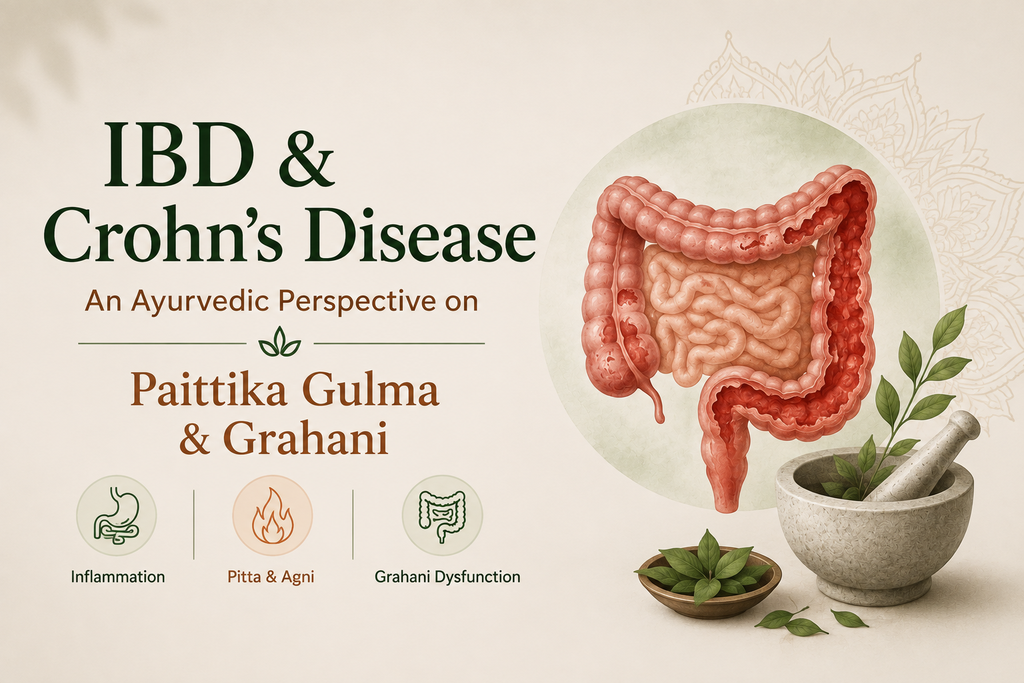
Introduction
Inflammatory Bowel Disease (IBD) is a group of chronic inflammatory disorders affecting the gastrointestinal tract. The two major forms are Crohn’s disease and ulcerative colitis. Crohn’s disease is characterized by inflammation that can involve different parts of the digestive tract, most commonly the small intestine and the beginning of the large intestine.
Common manifestations of Crohn’s disease include diarrhea, abdominal pain or cramping, weight loss, fatigue, reduced appetite and, in some individuals, anemia or fever. The presentation varies according to the location and severity of intestinal inflammation.
Ayurveda does not describe Crohn’s disease as a single classical disease entity. Therefore, attempting to identify Crohn’s disease as simply Grahani or Paittika Gulma would be an oversimplification.
However, several Ayurvedic principles provide interesting conceptual frameworks for discussing gastrointestinal inflammation and dysfunction. In particular, Agni, Pitta, Vata, Grahani, Srotas and Gulma can be considered when examining the clinical pattern.
This article explores the possible Ayurvedic correlation of Crohn’s disease with Paittika Gulma and Grahani, while maintaining a clear distinction between traditional Ayurvedic concepts and modern medical diagnosis.
What Is Inflammatory Bowel Disease?
Inflammatory Bowel Disease refers to chronic inflammatory disorders of the gastrointestinal tract. The two principal forms are:
- Crohn’s disease
- Ulcerative colitis
Although both are classified as IBD, they have important differences.
Ulcerative colitis primarily affects the colon, whereas Crohn’s disease can affect any part of the gastrointestinal tract from the mouth to the anus, although the small intestine and beginning of the large intestine are common sites.
The disease may follow a pattern of flares and remission, meaning that symptoms can become active and later decrease or disappear for periods of time.
Understanding Crohn’s Disease
Crohn’s disease is a chronic inflammatory condition of the digestive tract. Its exact cause is not completely understood. Current medical understanding suggests that interactions between genetic susceptibility, immune responses, environmental factors and the intestinal microbiome may contribute to disease development.
Common symptoms of Crohn’s disease include:
- Chronic or recurrent diarrhea
- Abdominal pain and cramping
- Weight loss
- Fatigue
- Reduced appetite
- Fever in some cases
- Anemia
- Nausea or vomiting
- Joint or skin manifestations in some individuals
The symptoms depend partly on which portion of the gastrointestinal tract is affected and how active the inflammation is.
Crohn’s disease can also produce complications such as ulcers, strictures, fistulas and abscesses in some patients.
How Is Crohn’s Disease Diagnosed?
Crohn’s disease cannot usually be diagnosed through a single test.
Medical evaluation may include:
- Medical and family history
- Physical examination
- Blood tests
- Stool tests
- Endoscopy
- Colonoscopy
- Biopsy
- CT or MRI imaging
- Other gastrointestinal investigations when required
Endoscopic examination with biopsy can be particularly important in evaluating intestinal inflammation and distinguishing Crohn’s disease from other conditions.
This distinction is important when discussing Ayurveda because an Ayurvedic conceptual assessment should not replace appropriate investigation of suspected IBD.
Crohn’s Disease Through an Ayurvedic Lens
Ayurveda approaches disease differently from modern biomedical medicine.
Rather than beginning with a disease label alone, Ayurvedic assessment considers factors such as:
- Dosha
- Agni
- Ama
- Dushya
- Srotas
- Sthana
- Prakriti
- Vikriti
- Nidana
- Individual symptoms and disease progression
For gastrointestinal disorders, Agni becomes particularly important.
The relationship between Agni and Grahani is central to the Ayurvedic understanding of digestion and bowel function. Classical descriptions of Grahani include disturbances of digestion and altered stool characteristics.
The Role of Agni in Gastrointestinal Disorders
Agni represents the principle of digestion and transformation in Ayurveda.
When Agni functions appropriately, food is properly processed and the physiological processes associated with digestion and nourishment can proceed normally.
When Agni becomes disturbed, Ayurveda describes various patterns of digestive dysfunction.
This is particularly relevant to Grahani because Grahani and Agni are closely interconnected in classical Ayurvedic descriptions.
From an Ayurvedic conceptual perspective, chronic gastrointestinal symptoms may therefore be examined through questions such as:
- Is Agni weak or irregular?
- Are there signs associated with excessive Pitta?
- Is Vata disturbed?
- Is Ama considered relevant?
- Is bowel function irregular?
- Which Srotas appear involved?
- What is the individual’s overall strength and nutritional status?
This individualized approach is different from assigning one modern disease directly to one Ayurvedic diagnosis.
Understanding Grahani in Ayurveda
Grahani is an important Ayurvedic concept related to digestion, retention and appropriate processing of food before elimination.
Classical descriptions associate Grahani with disturbed digestive function and abnormal bowel patterns.
Different doshic presentations are described, including:
- Vataja Grahani
- Pittaja Grahani
- Kaphaja Grahani
- Tridoshaja or mixed presentations
The classical description of Pittaja Grahani includes loose or watery stools, abnormal stool coloration, foul or sour eructation, burning sensations, reduced appetite and thirst.
These features demonstrate why Grahani can become an interesting conceptual framework when discussing chronic gastrointestinal symptoms.
However, Grahani should not automatically be equated with Crohn’s disease.
Pittaja Grahani and Crohn’s Disease
Pittaja Grahani becomes particularly relevant when gastrointestinal symptoms show a strong Pitta pattern.
Classically described features include:
- Loose or watery stools
- Digestive disturbance
- Burning sensations
- Thirst
- Reduced appetite
- Sour or foul eructation
- Pitta-associated changes in stool characteristics
Some of these manifestations can overlap with symptoms experienced by individuals with Crohn’s disease.
However, symptom overlap does not establish diagnostic equivalence.
Conceptual relationship
A possible Ayurvedic interpretation can be represented as:
Pitta disturbance
↓
Agni dysfunction
↓
Grahani dysfunction
↓
Altered digestion and bowel function
This is an Ayurvedic conceptual model and should not be interpreted as the modern pathophysiology of Crohn’s disease.
What Is Paittika Gulma?
Gulma is a classical Ayurvedic disease concept associated with abdominal manifestations and a localized mass-like or palpable abdominal presentation.
Classical descriptions recognize different types according to Dosha, including Vataja, Pittaja, Kaphaja and Sannipataja Gulma, along with other classifications in different contexts.
Paittika or Pittaja Gulma is associated with the involvement of Pitta and characteristic abdominal manifestations.
Classical discussions of Gulma describe variations in pain, location, digestive symptoms and other features according to the dominant Dosha.
Therefore, Paittika Gulma can be useful for understanding a Pitta-dominant abdominal disease pattern, but it should not be labeled as the Ayurvedic equivalent of Crohn’s disease.
Paittika Gulma and Crohn’s Disease: Where Is the Connection?
The possible connection is primarily conceptual, particularly when Crohn’s disease presents with prominent abdominal symptoms and features that can be interpreted through Pitta-related principles.
Possible areas of conceptual overlap
| Crohn’s disease | Paittika Gulma |
|---|---|
| Abdominal pain or discomfort | Abdominal pain is an important Gulma manifestation |
| Gastrointestinal inflammation | Pitta provides an Ayurvedic framework for heat and inflammatory-type features |
| Digestive disturbance | Agni is relevant in Ayurvedic interpretation |
| Variable abdominal symptoms | Gulma manifestations vary according to Dosha |
But there are also major differences.
Crohn’s disease is defined through modern clinical, endoscopic, histological and imaging criteria. Paittika Gulma belongs to a classical Ayurvedic disease framework.
Therefore, the relationship should be described as a conceptual correlation rather than a one-to-one diagnostic equivalence.
Grahani vs Paittika Gulma: Which Is More Relevant to Crohn’s Disease?
This is an important question.
The answer depends on the dominant clinical presentation.
Grahani may provide a broader conceptual framework when:
- Digestive dysfunction is prominent
- Stool irregularity is prominent
- Appetite and digestion are disturbed
- Chronic bowel dysfunction is present
- Agni disturbance is central to the clinical picture
Paittika Gulma may provide a conceptual framework when:
- Abdominal symptoms are prominent
- Pitta-associated manifestations dominate
- Heat or burning is prominent
- Abdominal pain is a major feature
- A Gulma-like abdominal presentation is considered clinically
Thus, it may be more appropriate to think in terms of overlapping Ayurvedic principles rather than trying to place every Crohn’s disease case into one classical category.
Pitta–Vata Interaction in Crohn’s Disease: An Ayurvedic Framework
One of the most useful Ayurvedic discussions of Crohn’s disease may involve the interaction between Pitta and Vata.
Pitta can be considered when inflammatory-type manifestations, heat, burning or irritation are prominent.
Vata becomes important because gastrointestinal movement, pain, irregularity and elimination are strongly associated with Vata principles.
This produces a possible conceptual framework:
Pitta aggravation
↓
Heat / irritation / inflammatory-type manifestations
Vata disturbance
↓
Pain / irregularity / altered bowel movement
↓
Agni disturbance
↓
Gastrointestinal dysfunction
This should be understood as an Ayurvedic interpretive model, not as a biomedical explanation for the development of Crohn’s disease.
The Role of Rakta in the Ayurvedic Interpretation
Rakta may become relevant when inflammatory or bleeding manifestations are present.
Ayurvedic literature gives considerable importance to the relationship between Pitta and Rakta.
Therefore, in an individual with gastrointestinal symptoms accompanied by bleeding, an Ayurvedic practitioner may consider the Pitta–Rakta relationship as part of the overall assessment.
However, rectal or intestinal bleeding requires proper medical evaluation because bleeding can occur for multiple reasons.
It should not be assumed to represent a particular Ayurvedic pathology without clinical assessment.
Ama and Crohn’s Disease: A Conceptual Discussion
Ama is an important Ayurvedic concept associated with improperly processed material and disturbed metabolic processes.
In gastrointestinal disorders, Ayurveda may consider Ama when symptoms suggest impaired digestion and incomplete processing.
However, Ama should not be equated directly with modern concepts such as inflammatory cytokines, intestinal bacteria, fecal calprotectin or other biomedical markers.
The two systems use different explanatory frameworks.
Therefore, it is more accurate to state:
Ama may be considered within an Ayurvedic assessment of gastrointestinal dysfunction, but it is not a direct biomedical synonym for intestinal inflammation.
Crohn’s Disease and Grahani: A Comparative View
| Feature | Crohn’s Disease | Grahani |
|---|---|---|
| Framework | Modern medicine | Ayurveda |
| Main focus | Chronic intestinal inflammation | Digestive and bowel dysfunction |
| Agni | Not an Ayurvedic disease concept | Central Ayurvedic concept |
| Pitta | Not used as a biomedical Dosha | Important in Pittaja presentation |
| Vata | Not used as a biomedical Dosha | Important in bowel regulation |
| Diarrhea | Common | Can occur |
| Abdominal pain | Common | Can occur |
| Altered digestion | Common symptom | Central conceptual feature |
| Direct equivalence | — | No |
The table highlights the difference between symptom overlap and diagnostic identity.
Crohn’s Disease and Paittika Gulma: A Comparative View
| Feature | Crohn’s Disease | Paittika Gulma |
|---|---|---|
| Framework | Modern medicine | Ayurveda |
| Primary focus | Intestinal inflammation | Abdominal Gulma pathology |
| Pitta | Not a biomedical category | Central to Paittika type |
| Abdominal pain | Common | Important feature |
| Digestive symptoms | Common | May occur |
| Agni | Not a biomedical construct | Important Ayurvedic consideration |
| Direct equivalent | — | No |
The strongest interpretation is therefore not that Crohn’s disease is Paittika Gulma, but that certain Crohn’s presentations may be discussed through selected Ayurvedic concepts associated with Pitta and abdominal pathology.
A Possible Ayurvedic Samprapti Framework
For educational discussion, an Ayurvedic conceptual sequence may be represented as:
Nidana
↓
Agni disturbance
↓
Dosha Prakopa
↓
Pitta–Vata involvement
↓
Gastrointestinal Srotas dysfunction
↓
Grahani dysfunction / abdominal manifestations
↓
Altered digestion and bowel function
The exact Samprapti would depend on the individual’s symptoms, Dosha involvement, Agni, strength, disease stage and other clinical factors.
Therefore, this framework should not be presented as a universal pathogenesis for every person with Crohn’s disease.
Modern Diagnosis and Ayurvedic Assessment
The two systems can be understood as answering different questions.
Modern medicine asks:
- Where is the inflammation?
- How extensive is it?
- How active is the disease?
- Are there complications?
- What does endoscopy show?
- What does histopathology show?
- What treatment is required?
Crohn’s disease diagnosis may involve blood and stool testing, endoscopy, biopsies and imaging.
Ayurveda asks:
- Which Dosha is predominant?
- What is the state of Agni?
- Is Ama present according to the Ayurvedic assessment?
- Which Srotas are involved?
- What is the individual’s Prakriti and Vikriti?
- What dietary and lifestyle factors may be relevant?
- What is the person’s overall strength and nutritional status?
These are different approaches and should not be represented as interchangeable diagnostic systems.
Can Crohn’s Disease Be Called Grahani?
Not automatically.
There may be similarities between Crohn’s disease and some features described under Grahani, particularly where chronic digestive dysfunction and altered bowel habits are prominent.
However, Crohn’s disease is a specific modern diagnosis based on clinical evaluation and objective investigations.
Therefore, a more accurate statement is:
Grahani may provide a useful Ayurvedic conceptual framework for discussing certain gastrointestinal manifestations of Crohn’s disease, but Crohn’s disease should not simply be equated with Grahani.
Can Crohn’s Disease Be Called Paittika Gulma?
Again, not as a direct equivalence.
Paittika Gulma describes a classical Ayurvedic disease pattern involving Pitta and abdominal manifestations.
Crohn’s disease is a chronic inflammatory bowel disease with its own modern diagnostic criteria.
The two may share certain conceptual features, particularly around abdominal symptoms and Pitta-associated manifestations, but they remain different disease frameworks.
Why an Integrative Perspective Requires Caution
Crohn’s disease can be chronic and potentially serious. Complications may include intestinal narrowing, fistulas, abscesses, ulcers and nutritional problems.
Current medical treatment aims to reduce intestinal inflammation, prevent flares and maintain remission. Treatment may include medicines and, in some circumstances, surgery.
For this reason, Ayurvedic concepts should be presented as a traditional interpretive framework, not as a replacement for diagnosis, monitoring or evidence-based medical care.
Any complementary Ayurvedic approach should be discussed with appropriately qualified healthcare professionals, particularly when someone has active IBD, significant bleeding, weight loss, anemia, fever, severe abdominal pain or suspected complications.
Frequently Asked Questions
What is the Ayurvedic equivalent of Crohn’s disease?
There is no universally accepted one-to-one Ayurvedic equivalent of Crohn’s disease. Depending on the individual’s presentation, concepts such as Grahani, Pittaja Grahani and Paittika Gulma may provide different points of conceptual comparison.
Is Crohn’s disease related to Grahani?
Some symptoms of Crohn’s disease can overlap with features described under Grahani, especially digestive dysfunction and altered bowel habits. However, Crohn’s disease and Grahani are not identical diagnoses.
What is Paittika Gulma?
Paittika Gulma is a classical Ayurvedic disease concept involving Pitta-associated abdominal manifestations. It should not be directly equated with Crohn’s disease.
What is Pittaja Grahani?
Pittaja Grahani is a Pitta-associated presentation within the classical Grahani framework. Classical descriptions include loose or watery stools, abnormal stool characteristics, burning sensations, thirst and digestive disturbances.
Is Crohn’s disease a Pitta disorder?
It would be too simplistic to classify Crohn’s disease as purely a Pitta disorder. An Ayurvedic assessment may consider Pitta, Vata, Agni, Ama, Srotas and other individual factors.
What is the role of Agni in Crohn’s disease from an Ayurvedic perspective?
Agni is central to Ayurvedic interpretation of digestive function. Disturbance of Agni may be considered when digestion, appetite and bowel function are altered. This is a traditional Ayurvedic framework and is not equivalent to modern inflammatory mechanisms.
Can Ayurveda cure Crohn’s disease?
It is not appropriate to claim that Ayurveda cures Crohn’s disease. Crohn’s disease requires appropriate medical diagnosis and monitoring. Ayurvedic care, if pursued, should be coordinated responsibly with conventional medical care.
Conclusion
Crohn’s disease is a complex form of Inflammatory Bowel Disease involving chronic inflammation of the gastrointestinal tract. Modern medicine approaches Crohn’s disease through clinical assessment, laboratory testing, endoscopy, biopsy and imaging, while Ayurveda approaches disease through concepts such as Dosha, Agni, Ama, Srotas, Prakriti and Vikriti.
From an Ayurvedic perspective, Grahani offers a particularly relevant conceptual framework when digestive dysfunction and altered bowel patterns are prominent. Pittaja Grahani becomes especially interesting when Pitta-associated manifestations such as loose stools, burning, thirst and digestive disturbance are present.
Paittika Gulma, meanwhile, provides a framework for considering Pitta-dominant abdominal manifestations and therefore may have conceptual relevance in selected presentations.
The most appropriate approach is not to state that Crohn’s disease equals Grahani or Paittika Gulma, but to examine how individual clinical features may be interpreted through different Ayurvedic principles.
The central conceptual model can therefore be summarized as:
Agni disturbance → Dosha imbalance → Pitta–Vata involvement → gastrointestinal dysfunction → Grahani/abdominal manifestations
This framework can support further academic discussion of the relationship between IBD, Crohn’s disease, Grahani, Pittaja Grahani and Paittika Gulma, while respecting the important differences between Ayurvedic and modern medical systems.