
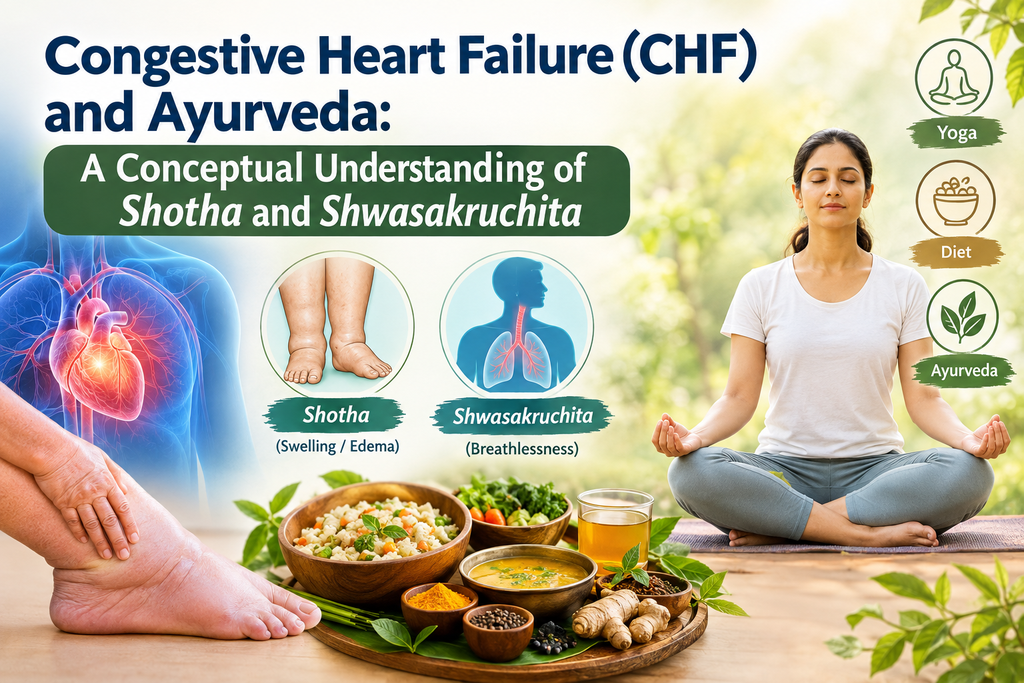
Introduction
Congestive heart failure (CHF), more broadly referred to as heart failure (HF), is a complex clinical syndrome in which the heart is unable to pump or fill adequately to meet the body’s circulatory requirements. Patients may experience breathlessness, reduced exercise tolerance, fatigue, swelling of the legs and ankles, difficulty lying flat and progressive fluid retention.
From an Ayurvedic perspective, there is no single classical disease entity that can simply be declared equivalent to modern congestive heart failure. However, several important manifestations of heart failure can be explored through Ayurvedic concepts such as Shotha, Shwasa, Shwasakruchita, Kleda, Kapha, Vata, Dhatu and Srotas.
Two particularly important clinical expressions are:
- Shotha — swelling or edema
- Shwasakruchita/Shwasa — difficulty or distress associated with breathing
This conceptual relationship can help create a dialogue between modern cardiovascular medicine and Ayurvedic pathophysiology.
Importantly, this should not be interpreted as meaning that congestive heart failure is simply another form of asthma or that all cardiac breathlessness should be classified as Tamaka Shwasa. The underlying pathology, diagnosis and treatment of heart failure remain fundamentally cardiovascular.
1. What Is Congestive Heart Failure?
Heart failure occurs when the heart’s structure or function becomes abnormal enough to produce symptoms and/or signs of congestion and inadequate cardiac output.
Heart failure can occur with:
- Reduced left ventricular ejection fraction
- Mildly reduced ejection fraction
- Preserved ejection fraction
- Predominantly left-sided dysfunction
- Predominantly right-sided dysfunction
- Combined ventricular involvement
The term “congestive” emphasizes the tendency toward accumulation of fluid within the pulmonary or systemic circulation.
Common manifestations include:
- Breathlessness during exertion
- Breathlessness while lying flat
- Reduced exercise tolerance
- Fatigue
- Swelling of the feet and ankles
- Rapid increase in body weight because of fluid retention
- Abdominal fullness or swelling
- Cough or pulmonary congestion in some patients
The severity of symptoms varies considerably between individuals.
Modern heart-failure management includes appropriate pharmacological therapy, treatment of the underlying cardiac disease, monitoring of volume status and, where appropriate, structured exercise or cardiac rehabilitation. Current guidelines specifically recommend exercise training or regular physical activity for eligible patients to improve functional status, exercise performance and quality of life.
2. Why Does Heart Failure Cause Swelling?
When cardiac function becomes inadequate, pressure can build up within the venous circulation.
Depending on the side and severity of cardiac dysfunction, this may contribute to:
- Pulmonary congestion
- Peripheral edema
- Ankle and foot swelling
- Abdominal fluid accumulation
- Weight gain
- Increased venous pressure
The clinical picture of fluid accumulation provides an important point of conceptual comparison with Shotha.
3. Understanding Shotha in Ayurveda
In Ayurveda, Shotha broadly refers to swelling or inflammatory/edematous enlargement of a body part or region.
The classical understanding of Shotha is more sophisticated than simply equating it with modern edema. Its manifestation can involve different Doshas, tissues, channels and underlying causes.
Depending upon the clinical context, Ayurvedic assessment may consider:
- Dosha predominance
- Agni
- Kleda
- Dhatu involvement
- Srotas
- Bala
- Prakriti
- The underlying Nidana
Therefore, the presence of swelling in a patient with heart failure can be discussed conceptually in relation to Shotha, but the two terms should not be treated as exact synonyms.
4. CHF-Related Edema and the Concept of Shotha
One of the most recognizable manifestations of congestive heart failure is dependent peripheral edema.
A patient may develop:
- Swelling around the ankles
- Heaviness of the lower limbs
- Tightness of footwear
- Pitting edema
- Progressive swelling during worsening congestion
From an Ayurvedic perspective, such manifestations can be explored through the interaction of:
Dosha → Kleda → Srotas → Dhatu → Shotha
Kapha and Kleda may be considered particularly relevant when there is heaviness, fluid accumulation and excessive moisture, while Vata may be considered in relation to movement and disturbed circulation.
However, these are interpretive Ayurvedic frameworks, not substitutes for the cardiovascular mechanisms recognized in contemporary medicine.
A patient with new or rapidly worsening edema requires medical evaluation because fluid accumulation may represent worsening heart failure, renal disease, liver disease, venous disease or another condition.
5. Understanding Shwasa and Shwasakruchita
The Ayurvedic concept of Shwasa relates broadly to disorders involving respiration and difficulty in breathing.
Shwasakruchita can be understood clinically as difficulty, discomfort or distress associated with breathing.
This makes it particularly interesting when studying heart failure because dyspnea is one of the most important symptoms of CHF.
However, Shwasa should not automatically be interpreted as bronchial asthma.
Ayurvedic descriptions of Shwasa encompass different clinical presentations and etiological patterns. Therefore, the physician should first identify the underlying pathology and then interpret the patient’s respiratory manifestation within the appropriate framework.
6. Why Does CHF Cause Shwasakruchita?
In left-sided heart failure, increased pressure within the pulmonary circulation can contribute to pulmonary congestion.
This may produce:
- Exertional breathlessness
- Difficulty breathing while lying down
- Breathlessness that wakes the patient at night
- Reduced exercise tolerance
- Respiratory discomfort
These manifestations provide a meaningful conceptual point of discussion with Shwasakruchita.
The Ayurvedic interpretation can consider disturbance of Pranavaha Srotas and the interaction of Doshas, but the modern physiological explanation—particularly pulmonary venous congestion—must not be ignored.
7. CHF Is Not the Same as Asthma
This distinction is extremely important.
Both bronchial asthma and heart failure may cause breathlessness, but their mechanisms are different.
Asthma is primarily an airway disorder characterized by variable airflow limitation and airway inflammation.
Heart failure can cause breathlessness because of cardiovascular dysfunction and pulmonary congestion.
Consequently:
Shwasakruchita is a clinical expression that may occur in different diseases; it does not mean that every patient with breathlessness has Tamaka Shwasa.
A patient with suspected heart failure should undergo appropriate cardiovascular assessment rather than being treated solely as an asthma patient.
8. Ayurvedic Pathophysiological Considerations
An Ayurvedic clinician may examine the patient through multiple dimensions.
Kapha
Kapha may be considered when there is:
- Heaviness
- Congestion
- Excessive Kleda
- Sluggishness
- Swelling
Vata
Vata may be relevant when there is:
- Disturbed movement
- Irregular functional activity
- Dyspnea associated with exertion
- Weakness
- Variable symptom expression
Pitta
Pitta assessment depends upon the underlying clinical picture and may become relevant when inflammatory, metabolic or heat-related features are prominent.
Kleda
Kleda is conceptually important when discussing excessive fluid or moistness in the body.
Srotas
Assessment may include consideration of:
- Pranavaha Srotas
- Rasavaha Srotas
- Ambuvaha-related concepts
- Other channels according to the patient’s presentation
These concepts should be individualized rather than mechanically applied to every CHF patient.
9. The Role of Agni and Ama
Agni is central to Ayurvedic assessment.
Poor dietary habits, sedentary behavior, irregular meals and impaired digestion may contribute to an unfavorable metabolic environment.
However, it is important not to label every patient with heart failure as having Ama.
An Ayurvedic assessment of Ama should be based on appropriate clinical features rather than simply associating chronic disease with Ama.
Similarly, dietary recommendations should not result in excessive fasting or nutritional restriction in a patient who may already be vulnerable to muscle wasting or cardiac cachexia.
10. Ayurvedic Dietetics in Congestive Heart Failure
Diet is an important part of heart-failure self-management.
Modern guidelines emphasize healthy dietary patterns and sodium management, although the optimal sodium threshold for every heart-failure patient remains an area of uncertainty. The 2022 AHA/ACC/HFSA guideline notes that aggressive sodium restriction has limited-quality evidence and that excessively restrictive diets can create nutritional problems.
Therefore, an Ayurvedic dietary plan should be individualized and medically supervised.
General Ayurvedic Dietary Principles
Prefer
- Freshly prepared meals
- Light, easily digestible foods when appropriate
- Adequate protein according to individual requirements
- Vegetables prepared with minimal salt
- Whole grains in appropriate portions
- Pulses if tolerated
- Seasonal fruits in appropriate portions
- Moderate use of suitable spices
- Regular meal timing
- Adequate nutritional density
Limit
- Excessively salty foods
- Pickles
- Papad
- Packaged soups
- Instant noodles
- Processed snacks
- Salted nuts
- Packaged sauces
- Highly processed foods
- Excessive fried foods
- Very large meals
- Excessive sweets
- Alcohol
Important point about fluids
Fluid restriction should not automatically be prescribed to every person with heart failure.
Fluid targets depend upon factors such as:
- Degree of congestion
- Serum sodium
- Kidney function
- Diuretic therapy
- Severity of heart failure
- Physician-directed treatment plan
The AHA/ACC/HFSA guideline notes that evidence supporting routine fluid restriction in all heart-failure patients is limited.
11. A Sample Ayurvedic-Inspired Daily Diet Pattern
This is an educational example rather than a universal prescription.
Early Morning
Warm water in a quantity appropriate to the individual’s fluid plan.
Avoid automatically recommending large quantities of water simply because it is considered “detoxifying.”
Breakfast
Choose one:
- Vegetable daliya
- Oats with appropriate toppings
- Light vegetable poha prepared with minimal salt
- Moong-based preparation
Mid-Morning
A suitable portion of fresh fruit according to:
- Diabetes status
- Kidney function
- Potassium level
- Fluid plan
Lunch
A balanced meal containing:
- Whole grain or appropriate cereal
- Moong dal or another suitable protein source
- Cooked vegetables
- Salad where appropriate
- Unsalted or minimally salted preparation
Evening
A light snack such as:
- Unsalted roasted option
- Small fruit portion
- Light herbal beverage if permitted within the fluid plan
Dinner
Dinner should generally be lighter than lunch.
Examples:
- Moong khichdi
- Vegetable soup prepared without excessive sodium
- Light vegetable and grain preparation
Before Bed
Avoid unnecessary fluid intake unless required by the patient’s prescribed fluid plan.
12. Important Potassium and Kidney Considerations
A common mistake in “heart-healthy” diets is recommending large amounts of potassium-rich foods without considering the patient’s medications and kidney function.
Some patients with heart failure may have:
- Chronic kidney disease
- Hyperkalemia
- Hypokalemia
- Diuretic-related electrolyte disturbances
- Medication-related changes in potassium
Therefore, foods such as bananas, coconut water, dried fruits and large quantities of potassium-rich foods should not automatically be prescribed in unlimited amounts.
The diet should be adjusted according to laboratory results and the patient’s medications.
13. Yoga in Congestive Heart Failure
Yoga may be considered a complementary component of rehabilitation in selected, medically stable patients.
A 2025 systematic review identified six randomized trials involving 296 people with heart failure and reported promising effects on quality of life, functional capacity and some clinical markers. However, the review also noted that safety and adherence outcomes remain insufficiently studied.
Therefore:
Yoga should not be presented as a treatment that reverses heart failure or replaces cardiology treatment.
The safest approach is gentle yoga integrated with conventional medical management and, where appropriate, cardiac rehabilitation.
14. Who Should NOT Start a Yoga Program Without Medical Clearance?
Yoga should be postponed and medical assessment obtained in patients with:
- Acute or worsening heart failure
- Breathlessness at rest
- Recent hospitalization for decompensated heart failure
- Uncontrolled arrhythmia
- Recent myocardial infarction
- Unstable angina
- Severe dizziness or fainting
- Severe uncontrolled blood pressure
- Significant fluid overload
- New chest pain
The patient should first be medically stabilized.
15. Suggested Gentle Yoga Schedule for Stable CHF
The following is an example educational schedule for medically stable patients who have been cleared for gentle exercise.
It is not a prescription for an individual patient.
Phase 1: Initial 1–2 Weeks
Morning — 15–20 minutes
1. Seated awareness — 2 minutes
Sit comfortably with the spine supported.
Observe natural breathing.
Do not force deep inhalation.
2. Gentle neck movements — 2 minutes
Slow movements only.
Avoid rapid rotations.
3. Shoulder movements — 2 minutes
Gentle shoulder rolls and arm movements.
4. Seated or supported Tadasana movement — 2 minutes
Gentle lengthening of the spine without breath-holding.
5. Gentle seated or supported side stretch — 2 minutes
Stay within a comfortable range.
6. Gentle breathing awareness — 3–5 minutes
Slow, comfortable breathing.
The objective is relaxation, not maximal inhalation.
7. Shavasana or supported relaxation — 3–5 minutes
Relax comfortably with appropriate support.
16. Phase 2: Weeks 3–4
If the patient remains clinically stable and the treating professional approves progression:
20–30 minutes
- 3–5 minutes: breathing awareness
- 3 minutes: joint mobility
- 5 minutes: supported standing movements
- 5 minutes: gentle walking
- 5 minutes: relaxation
- 3–5 minutes: quiet breathing/meditation
The intensity should remain low enough that the patient can speak comfortably.
17. Phase 3: Long-Term Routine
For stable patients who tolerate the previous phases:
Morning
5 minutes
- Breath awareness
- Gentle mobility
10 minutes
- Supported yoga movements
10–20 minutes
- Comfortable walking or medically prescribed aerobic activity
5–10 minutes
- Relaxation or meditation
The exact duration should be individualized.
Current heart-failure guidelines support exercise training or regular physical activity for eligible patients, and cardiac rehabilitation can improve functional capacity, exercise tolerance and quality of life.
18. Recommended Yoga Practices
For many stable patients, the emphasis should be on gentle, low-strain practices.
Potentially appropriate practices include:
- Sukhasana or supported sitting
- Gentle Tadasana
- Supported standing movements
- Gentle shoulder movements
- Gentle spinal mobility
- Cat-Cow-type movement if physically appropriate
- Gentle seated stretches
- Shavasana
- Yoga Nidra-style relaxation
- Mindfulness meditation
These should be selected according to the patient’s mobility, balance, symptoms and cardiovascular status.
19. Pranayama: A Cautious Approach
Breathing practices require particular care in heart failure.
Gentle, natural breathing and relaxation-based practices may be considered under appropriate supervision.
Avoid unsupervised:
- Forceful Kapalabhati
- Bhastrika
- Prolonged breath retention
- Aggressive alternate-nostril breathing
- Long breath holds
- Hyperventilation practices
The goal should be comfortable breathing and autonomic relaxation, not maximum respiratory effort.
If dizziness, breathlessness, chest discomfort or palpitations occur, stop immediately and seek appropriate medical advice.
20. Sample Weekly Yoga Schedule
| Day | Morning Practice | Duration |
|---|---|---|
| Monday | Gentle yoga + breathing awareness + relaxation | 20–25 min |
| Tuesday | Comfortable walking + relaxation | 20–30 min |
| Wednesday | Gentle yoga + mobility | 20–25 min |
| Thursday | Walking/cardiac rehabilitation activity | 20–30 min |
| Friday | Gentle yoga + breathing awareness | 20–25 min |
| Saturday | Walking + gentle stretching | 20–30 min |
| Sunday | Relaxation, meditation and very gentle mobility | 15–20 min |
The schedule should be modified according to symptoms, functional capacity and the patient’s cardiac rehabilitation plan.
21. What Should Be Avoided in CHF Yoga?
Avoid making heart failure patients perform:
- Intense power yoga
- Hot yoga
- Long static holds
- Advanced inversions
- Headstand
- Shoulder stand
- Forceful breathing
- Breath retention
- Rapid Surya Namaskar
- Exercises producing marked breathlessness
- Any movement causing chest discomfort or dizziness
The objective is gentle conditioning, mobility, relaxation and functional improvement, not athletic performance.
22. Ayurvedic Lifestyle Management
Alongside diet and medically appropriate physical activity, Ayurvedic lifestyle principles may emphasize:
Dinacharya
Maintain a regular daily routine.
Nidra
Aim for adequate and regular sleep.
Ahara
Eat appropriate quantities at regular times.
Vihara
Avoid prolonged inactivity while also avoiding overexertion.
Manasika Shamana
Stress-management practices such as meditation and gentle relaxation may be useful.
Weight Monitoring
For a person with heart failure, daily weight monitoring may help detect fluid changes. A sudden increase should be discussed according to the patient’s heart-failure action plan.
23. Ayurvedic Medicines: An Important Safety Consideration
It is tempting to approach CHF with herbal diuretics or “heart-strengthening” preparations.
This requires considerable caution.
Patients with heart failure commonly take medications that influence:
- Blood pressure
- Heart rate
- Kidney function
- Potassium
- Sodium
- Fluid balance
- Blood coagulation
Adding an Ayurvedic preparation without reviewing the complete medication list can potentially cause interactions or electrolyte disturbances.
Therefore, Ayurvedic medicines should be selected by a qualified clinician who understands both Ayurvedic pharmacology and the patient’s cardiovascular treatment.
Prescribed heart-failure medication should never be stopped or reduced in favor of Ayurveda without the treating cardiologist’s direction.
24. Ayurveda and Modern Cardiology: An Integrative Model
A practical integrative model can be summarized as:
Modern diagnosis
↓
Determine type and severity of heart failure
↓
Stabilize cardiovascular condition
↓
Assess Shotha, Shwasakruchita, Dosha, Agni, Kleda and Srotas
↓
Individualize Ahara and Vihara
↓
Introduce medically appropriate yoga/rehabilitation
↓
Monitor weight, symptoms, blood pressure and relevant laboratory parameters
↓
Continue guideline-directed cardiovascular treatment
This approach respects both the strengths of modern cardiology and the individualized framework of Ayurveda.
25. When Should the Patient Seek Urgent Medical Attention?
A patient with heart failure should seek urgent medical assessment for:
- Severe or sudden breathlessness
- Breathlessness at rest
- New or severe chest pain
- Fainting
- Severe dizziness
- Bluish lips or fingers
- Rapid worsening of swelling
- Marked sudden weight gain
- New confusion
- Severe palpitations
- Inability to lie down because of breathlessness
These symptoms should never be managed exclusively through home remedies, yoga or Ayurvedic treatment.
26. Key Ayurvedic Interpretation
From a conceptual standpoint, the relationship may be represented as:
Congestion → Shotha
Fluid accumulation and peripheral edema may be discussed through the Ayurvedic concept of Shotha.
Respiratory distress → Shwasakruchita
Cardiac pulmonary congestion and consequent dyspnea can be discussed through Shwasakruchita/Shwasa.
Fluid/metabolic disturbance → Kleda
Kleda may provide an additional conceptual framework for understanding fluid-related pathology.
Functional movement → Vata
Vata may be considered in relation to disturbed movement and circulation.
Heaviness/congestion → Kapha
Kapha may be relevant when heaviness, accumulation and congestion predominate.
But these are conceptual Ayurvedic correlations, not statements that modern CHF and classical Shotha or Shwasa are identical diseases.
27. Conclusion
Congestive heart failure presents a valuable opportunity for dialogue between modern cardiovascular medicine and Ayurvedic clinical reasoning.
From the modern perspective, heart failure involves complex abnormalities of cardiac structure or function that can result in congestion, reduced exercise capacity and breathlessness.
From an Ayurvedic conceptual perspective, manifestations such as peripheral edema may be examined through Shotha, while respiratory difficulty may be explored through Shwasa and Shwasakruchita. Concepts such as Dosha, Kleda, Agni, Dhatu and Srotas can provide an individualized framework for understanding the patient’s presentation.
However, the relationship should remain conceptual rather than literal. CHF should not be equated with asthma or automatically classified as Tamaka Shwasa simply because both conditions can produce breathlessness.
Dietary management should emphasize nutritional adequacy, appropriate sodium intake and individualized fluid management. Yoga may be incorporated as a gentle complementary practice in medically stable patients, particularly within a structured rehabilitation approach. Current heart-failure guidelines support appropriately selected physical activity and cardiac rehabilitation, while research specifically examining yoga in heart failure remains promising but limited.
The most responsible Ayurvedic approach to CHF is therefore not to replace modern cardiology, but to provide individualized Ahara, Vihara, yoga, stress management and supportive Ayurvedic care alongside appropriate cardiovascular treatment and monitoring.
Frequently Asked Questions
Is congestive heart failure the same as Shotha?
No. Shotha is an Ayurvedic clinical concept involving swelling, while congestive heart failure is a modern cardiovascular syndrome. Edema associated with CHF can be discussed conceptually in relation to Shotha.
Is heart failure the same as Shwasa Roga?
No. Breathlessness is an important manifestation of heart failure, and this may be conceptually related to Shwasakruchita/Shwasa, but CHF should not automatically be classified as a classical Shwasa disorder.
Is CHF the same as asthma?
No. Cardiac breathlessness and bronchial asthma have different underlying mechanisms. A patient with unexplained breathlessness requires proper medical diagnosis.
Can a person with CHF practice yoga?
Some medically stable patients can participate in appropriately modified yoga or cardiac rehabilitation. Exercise should be individualized and medically cleared, particularly after hospitalization or in symptomatic disease.
Which yoga is best for CHF?
There is no single universally prescribed yoga protocol. Gentle mobility, relaxation, comfortable breathing and appropriately dosed physical activity are preferable to strenuous or breath-retention practices.
Should CHF patients restrict water?
Not automatically. Fluid restriction depends on the individual’s clinical condition, sodium level, kidney function, congestion and treating physician’s recommendations.
Can Ayurveda replace heart-failure medicines?
No. Ayurvedic care should be considered complementary unless a qualified medical team determines otherwise. Guideline-directed cardiovascular treatment remains essential.
Can Ayurvedic herbs be taken with heart-failure medicines?
Not automatically. Potential interactions with cardiovascular drugs and effects on blood pressure, kidney function and electrolytes must be considered before adding any herbal preparation.