
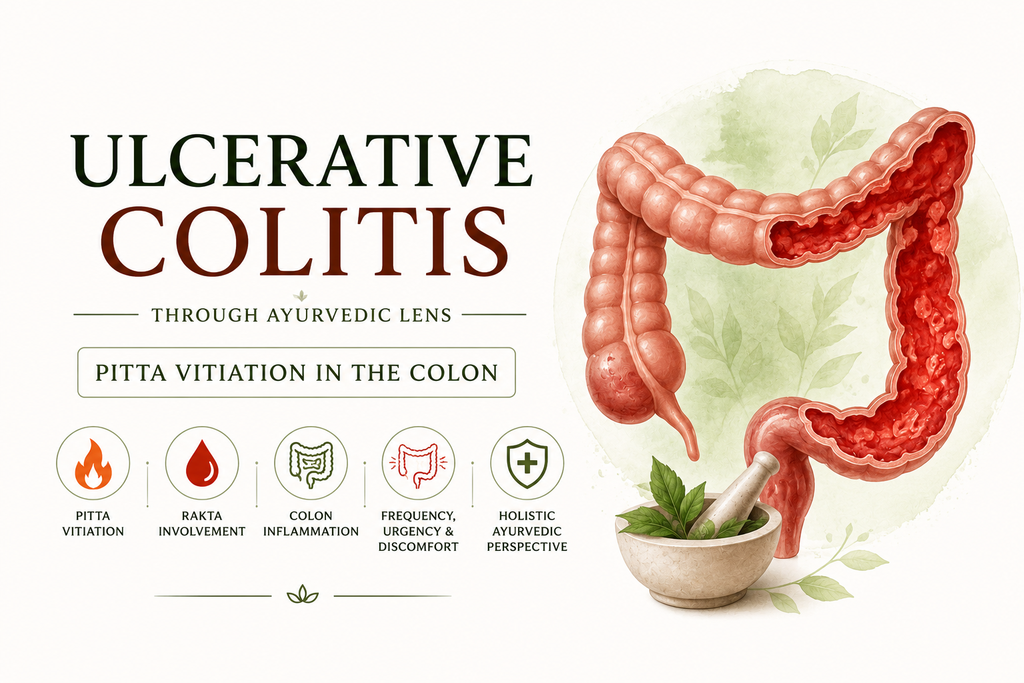
Ulcerative colitis (UC) is a chronic inflammatory condition affecting the large intestine, particularly the colon and rectum. Common symptoms may include frequent loose stools, urgency, abdominal discomfort, mucus, and rectal bleeding.
From an Ayurvedic perspective, the clinical features of ulcerative colitis can be explored through the principles of Pitta, Rakta, Agni, Apana Vata, and Pakvashaya. Among these, the concept of Pitta vitiation in the colon provides an important framework for understanding inflammatory and bleeding-related manifestations.
However, ulcerative colitis is a modern medical diagnosis, and there is no single classical Ayurvedic disease entity that can be considered its exact equivalent. Instead, Ayurveda provides several concepts that may help interpret different aspects of the condition.
This article explores the relationship between ulcerative colitis and Ayurvedic concepts such as Raktatisara, Pittaja Grahi, Raktapitta, and Vatarakta, with particular emphasis on the role of Pitta in the colon.
What Is Ulcerative Colitis?
Ulcerative colitis is a form of inflammatory bowel disease (IBD) in which inflammation and ulceration develop in the lining of the colon and rectum.
The condition may have periods of active symptoms, commonly referred to as flares, followed by periods of reduced or absent symptoms.
Common manifestations can include:
- Frequent bowel movements
- Loose or poorly formed stools
- Rectal bleeding
- Mucus in the stool
- Abdominal discomfort or cramping
- Bowel urgency
- A feeling of incomplete bowel evacuation
- Fatigue, particularly when disease activity or blood loss is significant
The severity and presentation can vary considerably between individuals.
Because ulcerative colitis can cause significant intestinal inflammation and bleeding, persistent symptoms should be evaluated by a qualified medical professional.
Ulcerative Colitis Through the Ayurvedic Lens
Ayurveda approaches disease through the interaction of Dosha, Dhatu, Agni, Srotas, and affected anatomical sites.
For understanding colonic inflammatory conditions, several principles become particularly relevant:
Pitta – associated with transformation, heat and metabolic processes.
Rakta – closely associated with Pitta and relevant when bleeding or Rakta-related manifestations are present.
Agni – responsible for digestion and transformation.
Apana Vata – governs functions of the lower gastrointestinal tract, including elimination.
Pakvashaya – the large intestine/colon region, traditionally associated strongly with Vata.
This creates an important Ayurvedic question:
What happens when Pitta becomes aggravated in a Vata-dominant region such as Pakvashaya?
This question forms the basis for understanding the concept of Pitta vitiation in the colon.
Understanding Pitta Vitiation in the Colon
The Pakvashaya is traditionally regarded as an important seat of Vata, while Pitta is associated with heat, transformation and inflammatory-type processes.
When Pitta becomes aggravated and its qualities become excessive, symptoms associated with heat, irritation, burning and inflammation may become prominent.
If this process involves the colon, it may conceptually contribute to a pattern involving:
Pitta aggravation
↓
Irritation and inflammatory tendency
↓
Rakta involvement
↓
Mucosal bleeding-type manifestations
↓
Disturbance of bowel function
↓
Interaction with Apana Vata
This does not mean that Ayurveda describes ulcerative colitis using exactly the same pathological mechanism as modern gastroenterology. Rather, it demonstrates how Ayurvedic principles can be used to interpret a pattern of symptoms.
Why Is Pitta Important in Colonic Inflammation?
Pitta and Rakta have a close relationship in Ayurvedic physiology and pathology.
When Pitta becomes aggravated, its qualities such as ushna (heat) and tikshna (sharpness) may become excessive. In an Ayurvedic interpretation, this may be associated with inflammatory or irritative manifestations.
When Rakta becomes involved, manifestations such as bleeding may become more prominent.
This is particularly relevant when considering an inflammatory bowel presentation involving:
- Blood in stool
- Burning sensations
- Increased bowel frequency
- Irritation
- Loose stools
- Urgency
- Signs suggesting inflammatory activity
Thus, an Ayurvedic interpretation of ulcerative colitis may involve the combined consideration of Pitta and Rakta, while also assessing the role of Apana Vata and Agni.
Role of Apana Vata in Ulcerative Colitis
Although Pitta may be important in an inflammatory presentation, the colon is fundamentally associated with Vata, particularly Apana Vata.
Apana Vata governs downward movement and elimination.
When intestinal inflammation and altered bowel function occur, the normal pattern of elimination may become disturbed.
From an Ayurvedic perspective, this creates a potential interaction:
Pitta → inflammatory/irritative component
Rakta → bleeding-related component
Apana Vata → altered elimination, urgency and bowel irregularity
Therefore, looking at ulcerative colitis exclusively as a Pitta disorder may provide an incomplete picture.
A more comprehensive Ayurvedic assessment considers the interaction between Pitta, Rakta and Apana Vata, together with the state of Agni and the affected gastrointestinal tissues.
Ulcerative Colitis and Raktatisara
Among classical Ayurvedic concepts, Raktatisara may have an important conceptual similarity to some presentations of ulcerative colitis.
The term can broadly be understood as Atisara (diarrheal/frequent bowel evacuation) associated with Rakta (blood).
Ulcerative colitis can also present with frequent stools accompanied by rectal bleeding.
Similarities
- Frequent or loose bowel movements
- Blood associated with stool
- Pitta-related manifestations may be prominent
- Rakta involvement is relevant
Important difference
Raktatisara is a classical Ayurvedic disease concept, whereas ulcerative colitis is a modern diagnosis based on clinical, endoscopic, histological and other medical assessments.
Therefore:
Ulcerative colitis should not automatically be diagnosed as Raktatisara.
Instead, Raktatisara can be discussed as a conceptual comparison for the combination of diarrhea and bleeding.
Ulcerative Colitis and Pittaja Grahni
Grahi refers to a pathological state involving impaired or altered bowel function, and the concept of Pittaja Grahi becomes relevant when Pitta-associated features are prominent.
An Ayurvedic assessment may consider symptoms such as:
- Altered stool consistency
- Abnormal bowel frequency
- Digestive disturbance
- Burning or heat
- Pitta-dominant symptoms
The overlap with ulcerative colitis is therefore primarily symptomological and conceptual, rather than a direct diagnostic equivalence.
Pittaja Grahi may help explain a Pitta-dominant pattern of bowel dysfunction, but it should not be used as a substitute for modern diagnostic evaluation of suspected ulcerative colitis.
Ulcerative Colitis and Raktapitta
Raktapitta is another important classical concept when discussing abnormal bleeding associated with Pitta and Rakta.
The connection becomes relevant because ulcerative colitis may involve rectal bleeding.
From an Ayurvedic perspective, the Pitta–Rakta relationship can therefore provide a useful theoretical framework for discussing bleeding manifestations.
However, the two conditions should not be equated.
Conceptual connection
Pitta aggravation → Rakta involvement → bleeding manifestation
In ulcerative colitis, rectal bleeding occurs because of inflammatory damage to the intestinal lining. Ayurveda and modern medicine are therefore describing the phenomenon through different conceptual frameworks.
Why Vatarakta Is Different
Vatarakta is often mentioned when discussing disorders involving the interaction of Vata and Rakta.
However, it is important to distinguish Vatarakta from gastrointestinal disorders.
Vatarakta is primarily discussed in relation to manifestations involving the musculoskeletal and peripheral tissues rather than being a classical description of ulcerative colitis.
Therefore, its relevance to this discussion is limited.
The useful conceptual lesson is the interaction between Vata and Rakta, but Vatarakta should not be presented as an Ayurvedic equivalent of ulcerative colitis.
Comparative View: Ulcerative Colitis and Ayurvedic Concepts
| Concept | Main Ayurvedic association | Possible conceptual overlap with UC |
|---|---|---|
| Raktatisara | Atisara associated with Rakta | Frequent/loose stools with blood |
| Pittaja Grahi | Pitta-associated bowel dysfunction | Pitta-dominant digestive and bowel manifestations |
| Raktapitta | Pitta–Rakta and abnormal bleeding | Bleeding-related presentation |
| Vatarakta | Vata–Rakta interaction | Limited conceptual relevance; not a direct GI equivalent |
| Pakvashaya | Important site of Vata | Anatomical relevance to the colon |
| Apana Vata | Elimination and lower GI function | Bowel movement and evacuation |
| Pitta | Heat, transformation and inflammatory-type features | Inflammatory/irritative symptom pattern |
| Rakta | Blood tissue and Pitta association | Conceptually relevant to rectal bleeding |
Pitta–Rakta–Vata: A Broader Ayurvedic Model
A useful way to understand the Ayurvedic perspective is not to search for one classical disease name, but to examine the interacting doshic and tissue factors.
1. Pitta
Pitta may be considered when heat, burning, irritation and inflammatory-type manifestations are prominent.
2. Rakta
Rakta becomes particularly relevant when bleeding or Rakta-related manifestations are present.
3. Apana Vata
Because the colon and elimination are strongly associated with Vata, Apana Vata must also be considered when bowel frequency, urgency or altered elimination occurs.
4. Agni
The state of Agni is important because digestion and transformation influence gastrointestinal function.
5. Pakvashaya
The colon represents the primary anatomical region involved in ulcerative colitis and is an important site for Vata consideration in Ayurveda.
This leads to a broader conceptual model:
Pitta aggravation
↓
Pitta–Rakta interaction
↓
Inflammatory/bleeding manifestations
Apana Vata disturbance
↓
Altered bowel function
↓
Pakvashaya involvement
This is an Ayurvedic conceptual framework, not a replacement for modern pathological diagnosis.
Is Ulcerative Colitis a Pitta Disorder in Ayurveda?
It would be overly simplistic to classify every case of ulcerative colitis as purely Pitta-dominant.
Different individuals may present with different combinations of:
- Pitta features
- Rakta involvement
- Vata disturbance
- Agni impairment
- Digestive symptoms
- Tissue involvement
Therefore, Ayurvedic assessment should be individualized rather than based solely on the disease name.
A person with prominent burning, inflammation and bleeding may demonstrate a stronger Pitta–Rakta pattern, while another person may show greater Vata-related bowel irregularity.
This is one reason why Ayurvedic clinical assessment traditionally considers the individual presentation rather than simply assigning a disease label.
Pitta Vitiation in the Colon: The Central Concept
The key concept can be summarized as follows:
The colon is predominantly associated with Vata, but when aggravated Pitta influences the Pakvashaya, Pitta-related inflammatory and irritative features may become prominent. When Rakta is involved, bleeding manifestations may also appear. At the same time, Apana Vata can become disturbed, contributing to altered bowel function.
This provides a framework for understanding why an Ayurvedic discussion of ulcerative colitis may need to consider Pitta, Rakta and Vata together, rather than focusing on only one Dosha.
Modern Medicine and Ayurveda: Two Different Frameworks
Modern medicine and Ayurveda approach ulcerative colitis from different theoretical foundations.
Modern medicine focuses on:
- Intestinal inflammation
- Mucosal ulceration
- Disease distribution
- Endoscopic findings
- Histopathology
- Laboratory markers
- Clinical disease activity
Ayurveda approaches the presentation through:
- Dosha
- Dushya
- Agni
- Srotas
- Sthana
- Disease progression
- Individual constitution and symptom pattern
These frameworks should not be presented as scientifically identical.
Instead, Ayurvedic concepts can be studied as a traditional interpretive framework, while modern medical diagnosis remains essential for identifying and monitoring ulcerative colitis.
Can Ayurveda Replace Conventional Treatment for Ulcerative Colitis?
Ulcerative colitis can be a serious chronic inflammatory bowel disease and may require ongoing medical management.
Anyone experiencing persistent diarrhea, rectal bleeding, unexplained weight loss, severe abdominal pain, fever, dehydration or other concerning symptoms should seek appropriate medical evaluation.
Ayurvedic approaches should not be presented as a replacement for prescribed medical treatment without appropriate clinical supervision.
An integrative approach, where appropriate, should prioritize patient safety and coordination between qualified healthcare professionals.
Frequently Asked Questions
Is ulcerative colitis the same as Raktatisara?
No. Raktatisara is a classical Ayurvedic disease concept involving Atisara with Rakta, while ulcerative colitis is a modern medical diagnosis involving chronic inflammation of the colon and rectum. They may share certain clinical features, but they should not be considered identical.
Is ulcerative colitis caused by Pitta according to Ayurveda?
Ayurveda may interpret Pitta aggravation as an important component in inflammatory and bleeding-dominant presentations. However, ulcerative colitis should not automatically be classified as a purely Pitta disorder.
Why is Rakta important in ulcerative colitis?
Rectal bleeding is a common manifestation in some people with ulcerative colitis. From an Ayurvedic perspective, Rakta is closely associated with Pitta, making the Pitta–Rakta relationship relevant to conceptual discussion.
What is the role of Apana Vata?
Apana Vata governs downward movement and elimination and is closely associated with the lower gastrointestinal tract. Its involvement may be considered when bowel frequency, urgency or altered elimination is present.
Is Vatarakta an Ayurvedic equivalent of ulcerative colitis?
No. Vatarakta primarily concerns Vata–Rakta pathology in tissues outside the gastrointestinal tract, particularly musculoskeletal manifestations. It should not be presented as an equivalent of ulcerative colitis.
What is the Ayurvedic view of Pitta in the colon?
The colon is strongly associated with Vata, but aggravated Pitta may influence the Pakvashaya and contribute conceptually to heat, irritation and inflammatory-type manifestations. When Rakta is involved, bleeding may also be considered within the Ayurvedic framework.
Conclusion
Ulcerative colitis can be explored through Ayurveda using a multidimensional framework rather than forcing it into a single classical disease category.
The concept of Pitta vitiation in the colon becomes particularly interesting when inflammatory, burning and bleeding features are present. The involvement of Rakta may help explain the conceptual relationship with conditions such as Raktatisara and Raktapitta, while Apana Vata remains important because of its relationship with the colon and elimination.
Among the classical concepts discussed, Raktatisara, Pittaja Grahi and Raktapitta offer different points of conceptual comparison, whereas Vatarakta has considerably less direct relevance to ulcerative colitis.
Ultimately, the Ayurvedic perspective can provide a traditional framework for understanding symptom patterns, but ulcerative colitis requires appropriate medical diagnosis and monitoring.
The central Ayurvedic concept can therefore be summarized as:
Pitta aggravation + Rakta involvement + Apana Vata disturbance + Pakvashaya involvement → a useful conceptual framework for discussing the Ayurvedic interpretation of inflammatory bowel manifestations.