
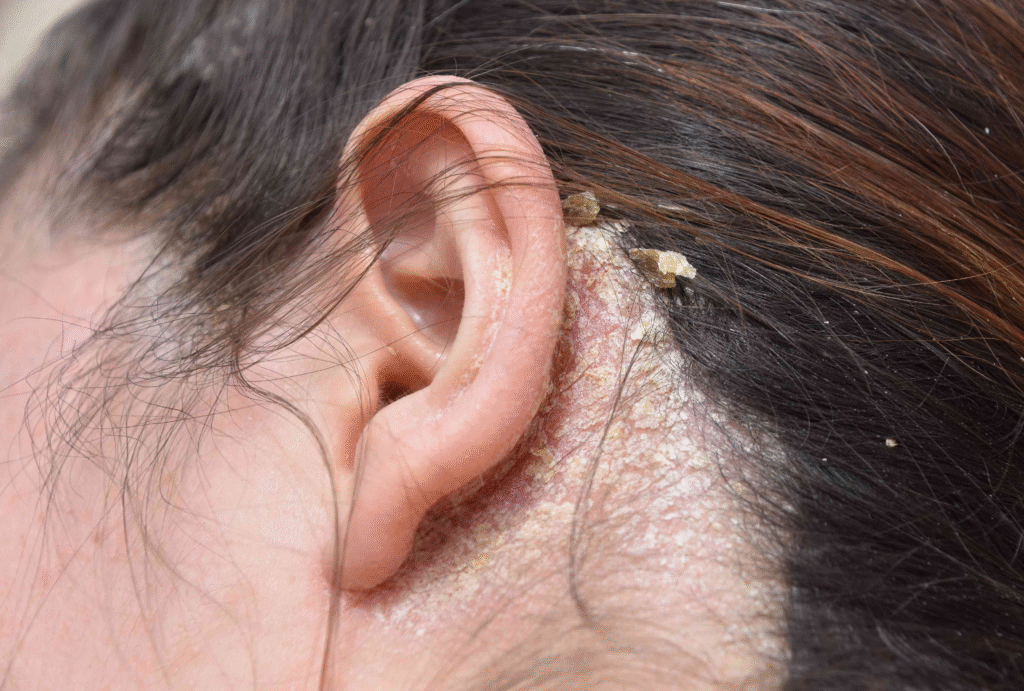
Skin disorders have long been a focus of both traditional and modern medicine, reflecting their profound impact on physical comfort, mental well-being, and quality of life. Siddhama Kushta (also spelled Sidhma Kushta), a subtype of skin disease described in ancient Ayurvedic texts, bears striking resemblances to seborrheic dermatitis, a common inflammatory condition in contemporary dermatology.
While Siddhama Kushta is rooted in Ayurveda’s holistic framework of doshic imbalances, seborrheic dermatitis is understood through the lens of microbiology, immunology, and environmental triggers. This article delves into the definitions, symptoms, causes, pathophysiological mechanisms, treatment approaches, and key research findings linking these conditions, highlighting their synergies and distinctions. By bridging traditional wisdom with modern science, we aim to provide a comprehensive understanding for practitioners, patients, and researchers.
What is Siddhama Kushta?
Siddhama Kushta is one of the 18 types of Kushta (skin diseases) outlined in classical Ayurveda, as detailed in texts like the Charaka Samhita and Sushruta Samhita. Kushta encompasses a broad spectrum of dermatological conditions characterized by skin discoloration (Vaivarnya), sensory impairment (Sparshaghnata), and doshic vitiation.
Acharya Charaka places it under Maha Kushta (major skin diseases) due to its potential chronicity and invasiveness into deeper tissues (Dhatus), while Acharya Sushruta and Vagbhata categorize it as Kshudra Kushta (minor skin diseases) owing to milder initial symptoms.
Symptoms of Siddhama Kushta
The hallmark features include:
- Lesion Appearance: Thin, white or coppery-red patches resembling the flower of Alabu (bottle gourd), with a rough, fissured periphery and smooth center. Lesions are dry externally but moist internally, producing fine scales when scratched (resembling candle grease).
- Location: Predominantly on the upper body, such as the chest (Urapradesh), back, and scalp.
- Associated Sensations: Mild itching (Kandu), roughness (Rukshata), and occasional burning (Daha). Unlike severe Kushtas, there is minimal pain, suppuration, or discharge.
- Progression: If untreated, it may evolve into deeper tissue involvement, leading to intractable symptoms.
These manifestations underscore its Kapha-Vata predominance, with Kapha contributing to scaling and Vata to dryness and fissuring.
Underlying Causes
In Ayurveda, Siddhama Kushta arises from the vitiation of Tridoshas (Vata, Pitta, Kapha), but primarily Kapha and Vata, combined with Dushyas (tissues) like Twak (skin) and Rakta (blood). Key etiological factors (Nidana) include:
- Dietary indiscretions: Consumption of incompatible foods (Viruddha Ahara), heavy, oily, or cold items.
- Lifestyle errors: Suppression of natural urges (Vega Vidharana), excessive exercise, or exposure to cold/dry environments.
- Microbial Influence: Aggravated Kapha creates a moist environment fostering Krimi (microorganisms), akin to fungal overgrowth.
The pathogenesis (Samprapti) involves doshas circulating and localizing in the skin’s superficial layer (Avabhasini), leading to obstruction (Srotorodha) and tissue malformation.
What is Seborrheic Dermatitis?
Seborrheic dermatitis (SD) is a chronic, relapsing inflammatory skin disorder affecting sebum-rich areas, recognized in modern dermatology as a papulosquamous condition. It manifests in two peaks: infantile (cradle cap) and adult forms, with a prevalence of 1-10% in adults and up to 70% in infants. SD is not contagious and often waxes and wanes with seasons, stress, or immune status.
Symptoms of Seborrheic Dermatitis
Common presentations include:
- Lesion Characteristics: Erythematous (red) patches with greasy, yellow-white scales or flakes; mild to moderate inflammation.
- Primary Sites: Scalp (dandruff in mild cases), face (eyebrows, nasolabial folds, ears), chest, and upper back.
- Sensations: Itching (pruritus), burning, or stinging; in severe cases, crusting or fissuring.
- Variants: Infantile SD features thick, yellowish scales on the scalp; adult SD may involve blepharitis or otitis externa.
Underlying Causes
The etiology is multifactorial:
- Microbial Role: Overgrowth of Malassezia yeast (a commensal fungus) in sebum, triggering inflammation via lipase activity and free fatty acid release.
- Immune and Genetic Factors: T-cell dysfunction, altered complement activation, and genetic predispositions (e.g., in Parkinson’s or HIV patients).
- Environmental Triggers: High sebum production, hormonal changes, stress, and poor hygiene.
Similarities and Differences: Pathophysiology
Pathophysiological Similarities
Both conditions share core mechanisms of inflammation and scaling in seborrheic areas, suggesting Siddhama Kushta as an Ayurvedic correlate to SD:
Ayurvedic Pathophysiology (Samprapti):
- Raktadushti (Blood Impurity): Initial vitiation of doshas contaminates Rakta (blood), leading to systemic toxicity.
- Twak Pradoshaja Vikara: Contaminated blood reaches Twak (skin) via Rasa-Rakta vaha srotas, causing localized inflammation.
- Kapha-Vata Avrita Twak: Kapha obstruction with Vata dryness creates characteristic “dry outside, moist inside” lesions.
- Krimi Sanghata: Moist environment fosters microbial proliferation (Krimi), mirroring Malassezia overgrowth.
Modern Correlation:
- Site Predilection: Upper body and scalp involvement, where sebaceous glands are abundant.
- Scaling and Itching: Fine, powdery scales (dust-like in Siddhama; greasy in SD) with pruritus.
- Inflammatory Basis: Raktadushti parallels immune dysregulation; both foster microbial proliferation (Krimi/Malassezia).
- Chronicity: Relapsing nature due to unresolved Rakta contamination and triggers.
Pathophysiological Differences
| Aspect | Siddhama Kushta | Seborrheic Dermatitis |
|---|---|---|
| Primary Mechanism | Raktadushti → Twak + Kapha-Vata + Krimi | Malassezia lipase → Free fatty acids |
| Tissue Involvement | Rakta, Twak, potential Dhatu invasion | Superficial epidermal |
| Lesion Texture | Dry outside, moist inside; thin/fissured | Greasy/yellow scales; erythematous |
| Systemic Component | Dosha-Dushya Sammurchana with blood impurity | Localized immune response |
Key Insight: Raktadushti explains Siddhama’s potential for chronicity and deeper tissue involvement, while SD remains primarily superficial.
Treatment Options
Ayurvedic Treatments for Siddhama Kushta
Ayurveda employs a tripartite approach: Nidana Parivarjana (avoiding causes), Shodhana (purification), and Shamana (palliative):
Raktashodhana Focus:
- Internal Therapies: Aragwadhadi Kashayam and Tiktakam Kashayam for Raktadushti correction, Kapha-Vata balance, and deep detoxification of skin and blood.
- Diet and Lifestyle: Avoid Viruddha Ahara; favor light, warm, Raktaprasadaka foods (pungent, bitter, astringent).
- External Applications: Lepa (pastes) with Khadira or Rasanjana; Takradhara (buttermilk pouring) for scalp.
- Panchakarma: Virechana (purgation) and Raktamokshana (bloodletting) specifically target Raktadushti in chronic cases.
Key Formulations:
- Aragwadhadi Kashayam: Contains Aragwadha (Cassia fistula), Nimba (Neem), and Patola; premier Raktashodaka for Kushta.
- Tiktakam Kashayam: Tikta (bitter) formulation with Patola, Nimba, and Guduchi; excellent for Pitta-Kapha predominant Raktadushti with scaling.
Modern Treatments for Seborrheic Dermatitis
Focus on symptom control and antifungal action:
- Topical Agents: Antifungal shampoos (ketoconazole 2%, selenium sulfide); mild corticosteroids (hydrocortisone) for inflammation.
- Systemic Options: Oral antifungals (e.g., itraconazole) for severe/refractory cases; calcineurin inhibitors (pimecrolimus) for facial use.
Comparative Insights
Ayurveda’s Raktadushti-centered approach addresses root causes through blood purification, complementing modern antifungals. Integrated protocols (Aragwadhadi Kashayam + ketoconazole) target both microbial overgrowth and systemic impurity, reducing relapse rates.
Relevant Research Findings
- Ayurvedic Correlations: Clinical studies show Aragwadhadi and Tiktakam Kashayams significantly reduce Raktadushti markers and scaling in Siddhama Kushta.
- Seborrheic Dermatitis Studies: 2014 review confirmed Malassezia’s role, paralleling Ayurveda’s Krimi concept.
- Integrated Evidence: 2019 studies validate Aragwadhadi’s antifungal activity against Malassezia, supporting Raktashodhana efficacy.
Conclusion
Siddhama Kushta and seborrheic dermatitis converge through Raktadushti and microbial triggers in seborrheic areas. Ayurveda’s blood purification paradigm (Aragwadhadi/Tiktakam Kashayams) offers preventive depth, while modern therapy provides symptomatic relief. Integrated treatment addressing both systemic impurity and local infection yields optimal, sustainable outcomes.
References
- Charaka Samhita, Chikitsa Sthana, Chapter 7 (Kushta Chikitsa). Chaukhamba Publications, Varanasi.
- Sushruta Samhita, Nidana Sthana, Chapter 5. Chaukhamba Publications.
- Sahasrayogam – Aragwadhadi Kashayam. Arya Vaidya Sala, Kottakkal.
- Ashtanga Hridaya – Tiktakam Kashayam formulation. Chaukhamba Publications.
- Schwartz JR, et al. (2014). A Comprehensive Pathophysiology of Dandruff and Seborrheic Dermatitis. Acta Dermato-Venereologica, 94(5):512-520.
- Adalsteinsson JA, et al. (2020). An Update on the Microbiology, Immunology, and Genetics of Seborrheic Dermatitis. Experimental Dermatology, 29(9):819-826.
- Bedi MK, et al. (2019). Herbal Interventions for Seborrheic Dermatitis. Evidence-Based Complementary and Alternative Medicine.